
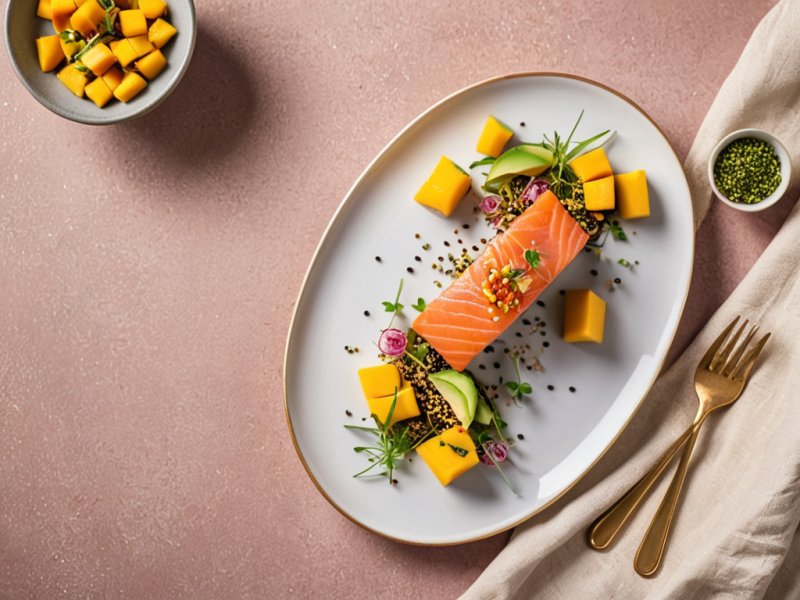
How to make Salmon and Mango Tartare?
This recipe takes 45 minutes for 4 servings (265 kcal/serving), medium difficulty.
A fresh salmon tartare enhanced by the exotic sweetness of mango, the kick of ginger and the freshness of lime. A refined and light appetizer, perfect for impressing your guests at a summer dinner.
15 min
Prep time
30 min
Rest
4
Servings
Medium
Difficulty
45 min
Total time
Lunch
Meal type
265
Calories
24g
Proteins
14g
Carbs
13g
Fats
Approximate nutritional values per serving
What ingredients for Salmon and Mango Tartare?
How to prepare Salmon and Mango Tartare?
-
1
Place the salmon fillet in the freezer for 20 minutes to firm it up and make cutting easier. Meanwhile, prepare the other ingredients.
-
2
Peel the mango and cut the flesh into small even cubes of about 1 cm. Set aside in the refrigerator in a bowl.
-
3
Remove the salmon from the freezer and cut it with a sharp knife into even 1 cm cubes. Never mince the fish, to preserve its melt-in-your-mouth texture.
-
4
In a large chilled bowl, combine the salmon and mango. Add the lime juice and zest, finely grated fresh ginger, sesame oil and soy sauce.
-
5
Gently mix with a spoon, without crushing the ingredients. Season lightly with salt (the soy sauce is already salty) and pepper. Add the snipped chives.
-
6
Cover the bowl with plastic wrap pressed directly onto the surface and refrigerate for 30 minutes to let the flavors meld.
-
7
When ready to serve, place a presentation ring in the center of each chilled plate. Divide the tartare among them, pressing down lightly, then carefully remove the ring.
-
8
Sprinkle with toasted sesame seeds and a few chive tips. Serve immediately with toasts or crispy chips.
Tips for making Salmon and Mango Tartare?
For a perfectly safe tartare, use salmon that has been frozen at -20°C for at least 24 hours. Lime can be replaced with yuzu for a Japanese twist. If mango is not in season, ripe avocado makes an excellent substitute with a complementary creamy texture.
Additional information
Salmon and mango tartare is an appetizer that combines elegance and simplicity. This surf-and-turf combination with exotic accents plays on contrasts: the melt-in-your-mouth raw salmon, the sweet softness of mango, the kick of ginger and the invigorating acidity of lime. A harmony of flavors that instantly transports you to the tropics.
Choosing the Salmon
For a tartare, the freshness of the fish is absolutely essential. Buy your salmon from a trusted fishmonger and specify that you wish to eat it raw. The salmon should be firm to the touch, display a beautiful uniform orange color and give off no unpleasant odor — fresh salmon smells pleasantly of the sea, nothing more.
Choose a skinless, boneless salmon fillet, preferably a thick piece cut from the back of the fish, which is meatier and more uniform. If possible, ask for salmon that has been previously frozen at -20°C for at least 24 hours, which eliminates any parasitic risk associated with consuming raw fish.
Preparing the Tartare
The success of a tartare lies in the cut: the salmon cubes should be uniform, about 1 cm per side, cut with a very sharp knife and never minced, which would destroy the texture. Work with the salmon very cold, or even partially frozen, to facilitate clean cutting.
The mango should be ripe but still firm, so it holds its shape in cubes without turning to mush. Cut it into cubes the same size as the salmon for visual harmony. Fresh ginger should be grated very finely — a Microplane grater is ideal — to diffuse its aroma without leaving fibrous pieces.
Plating and Presentation
The tartare is ideally plated using a presentation ring placed in the center of the plate. Gently press the tartare into the ring, carefully remove it and garnish the top with a few sesame seeds and some snipped chives. A drizzle of sesame oil around the plate adds a very elegant finishing touch.
Serve the tartare immediately after plating, accompanied by crispy toasts or wonton chips. Tartare should never wait — consumed within minutes of preparation, it offers its finest flavor expression.
Did you try this recipe?
Give your opinion and help other users!
Community photos
Did you try this recipe?
Frequently asked questions
This recipe serves 4 people. You can adjust the quantities directly on the page.
This recipe is medium difficulty. It is suitable for cooks with some basic skills.
Per serving: 265 kcal, 24g protein, 14g carbs and 13g fat.







Comments 0
Be the first to comment on this recipe!